
Identification guide
Is it a combination gas-and-electric chandelier?
A true combination fixture was built with separate gas burners and electric sockets on the same body. That is different from a gasolier later rewired for electricity. The strongest identification comes from the arm ends, controls, and internal paths—not ornament or an upward-facing shade by itself.
Start with the original system
“Gasolier” means a chandelier made for gas lamps; the Getty Art & Architecture Thesaurus notes that the term distinguishes these fixtures from electric and candle chandeliers. A combination chandelier goes a step further: it carries both services.
The distinction is visible in the Historic American Buildings Survey record for the Grant Building. Its original construction drawings specified gas piping, electrical wiring, and combination chandeliers ranging from two lights in small rooms to twelve lights in the dining hall. But the survey also cautions that early photographs appear to show only electric lights actually installed. The HABS data pages preserve both the documented design and that uncertainty.
Conversion is a different history. At the Longfellow House, the National Park Service documents original 1852 gasoliers that were converted after electricity was installed in 1924. A surviving fixture can therefore look transitional without having been a purpose-built combination fixture.
Dated primary evidence
What an 1882 patent actually shows
Sigmund Bergmann’s U.S. patent 262,271 for a combined gas-and-electric fixture diagrams a gas chandelier with separate tubes carrying incandescent lamps and insulated wires. The electric tubes are held apart from the gas tube by insulating clamps; one bracket drawing places the electric lamp below the gas arm. This is useful construction evidence, not a universal template: a surviving fixture may use a different patented arrangement or may have been altered later.
Side-by-side test
Combination fixture or later conversion?
| Evidence | Purpose-built combination | Gasolier converted to electric |
|---|---|---|
| Arm ends | A deliberate mix of gas cocks or burners and electric sockets. | Gas-era arms adapted with sockets, wiring, or replacement fittings. |
| Controls | Gas keys or valves remain associated with some arms, not every lamp. | Gas keys may survive as inactive remnants even though every arm is electric. |
| Service paths | Evidence of both hollow gas passages and insulated wire routes. | Wiring added through or alongside the original gas passages. |
| Best proof | Mixed original hardware plus drawings, catalog evidence, or an unchanged installation. | Documented electrification date, uniform later sockets, or visible alterations. |
Read shade direction cautiously
Upward-facing gas lights paired with downward-facing electric bulbs are a useful pattern, but not proof. A University of Georgia preservation study, drawing on Denys Peter Myers’s federal guide to American gaslighting, reports that most combination fixtures kept gaslights upright while also noting the introduction of inverted gas mantles in 1897. Treat direction as a clue to test against the fittings, not as a date or attribution by itself. Read the preservation study.
Direction can also mislead after the combination era. Scan page 15 of the 1920 E. R. Beers electric-lighting catalog shows electric wall brackets with upright candle-form sockets. The visible lamp orientation alone therefore cannot establish whether an arm carried gas or electricity.
Documented examples
Two transition stories

c. 1890s
Natchez Hotel dining room with combination chandeliers
This room view shows combination gas-and-electric fixtures in use, not as isolated museum objects—the old and new systems coexisted over the same dining tables.
Photographer uncredited, via Historic Natchez Foundation. Public domain. Source record.
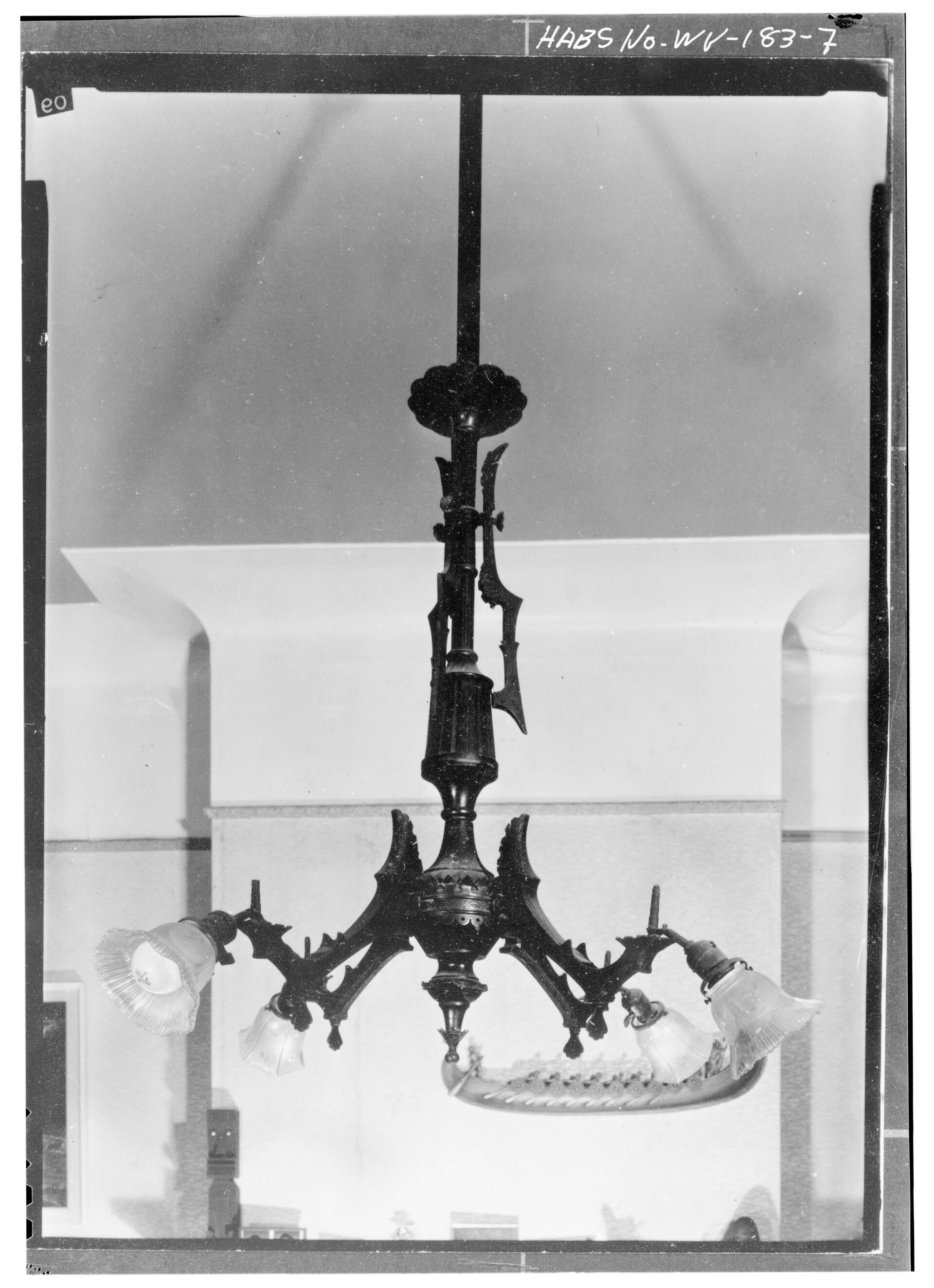
documented after 1933
Electrified gas chandelier, Irwin–Brues House
The surviving gas-era body and later electric shades make the transition in lighting technology visible in a single fixture.
Historic American Buildings Survey, Library of Congress. Public domain. Source record.
What to photograph and measure next
Photograph the whole fixture before removing shades. Then make close views of every different arm end, gas key or valve, socket shell, shade holder, center body, ceiling stem, and canopy. Include maker’s marks, patent dates, plugged holes, fresh drilling, and changes in metal color or finish.
Record the overall width and drop, the number of each arm type, and the inside diameter of every shade fitter. The fixture measuring guide shows where to take those dimensions. If parts are missing or altered, say so; a precise “unknown” is more useful than a confident date based on silhouette alone.
Safety before testing
Do not energize or reconnect an unknown fixture
Old wiring, abandoned gas passages, and ceiling support all need evaluation. The National Park Service’s historic-fixture rehabilitation plan assigns that work to a qualified lighting technician with historic-fixture and electrical-safety expertise. Have an appropriately qualified professional inspect the fixture before installation or testing.
Research sources
- Library of Congress, HABS DC-353-F—record, drawings, photographs, and data for the Grant Building, constructed 1910–1912.
- National Park Service, Longfellow House historic furnishings—documented 1852 gasoliers and their 1924 conversion.
- Getty Art & Architecture Thesaurus: gasoliers—controlled terminology for gas chandeliers.
- Sigmund Bergmann, U.S. patent 262,271—dated 1882 drawings and specification for a combined gas-and-electric bracket and chandelier.
- Deepannita Ghosh, “Illuminating the Past,” University of Georgia—preservation study of American artificial lighting, 1610–1930.
- National Park Service, Ahwahnee historic-light-fixture rehabilitation—a preservation project addressing electrical and seismic safety concerns through a qualified historic-lighting technician.