
Glass-shade field guide
Schoolhouse shades: shape, size, and fit
A schoolhouse shade is the stepped opal-glass form with a broad lower bowl, a narrower shoulder, and a neck that enters its holder. The familiar name is useful shorthand, but shape alone does not tell you the fitter size or whether the glass belongs on a flush, stem-hung, or chain-hung fixture.
Read the silhouette
Three features make the form recognizable
Broad lower bowl
The main light-diffusing body spreads wider than the neck instead of continuing as a simple sphere or bell.
Stepped shoulder
A visible ledge or rounded step separates the wide body from the narrower upper section.
Straight neck
The upper glass narrows into the portion supported by the holder. That neck—not the shade’s widest point—is the fitter measurement.
Do not use “schoolhouse” as proof of a room, maker, or exact date. A plain opal globe may have a related purpose without this stepped profile, while a current reproduction may copy the outline closely. Record construction, holder, dimensions, and markings before making a historical attribution.
Dated evidence
The shade shape did not dictate one mounting
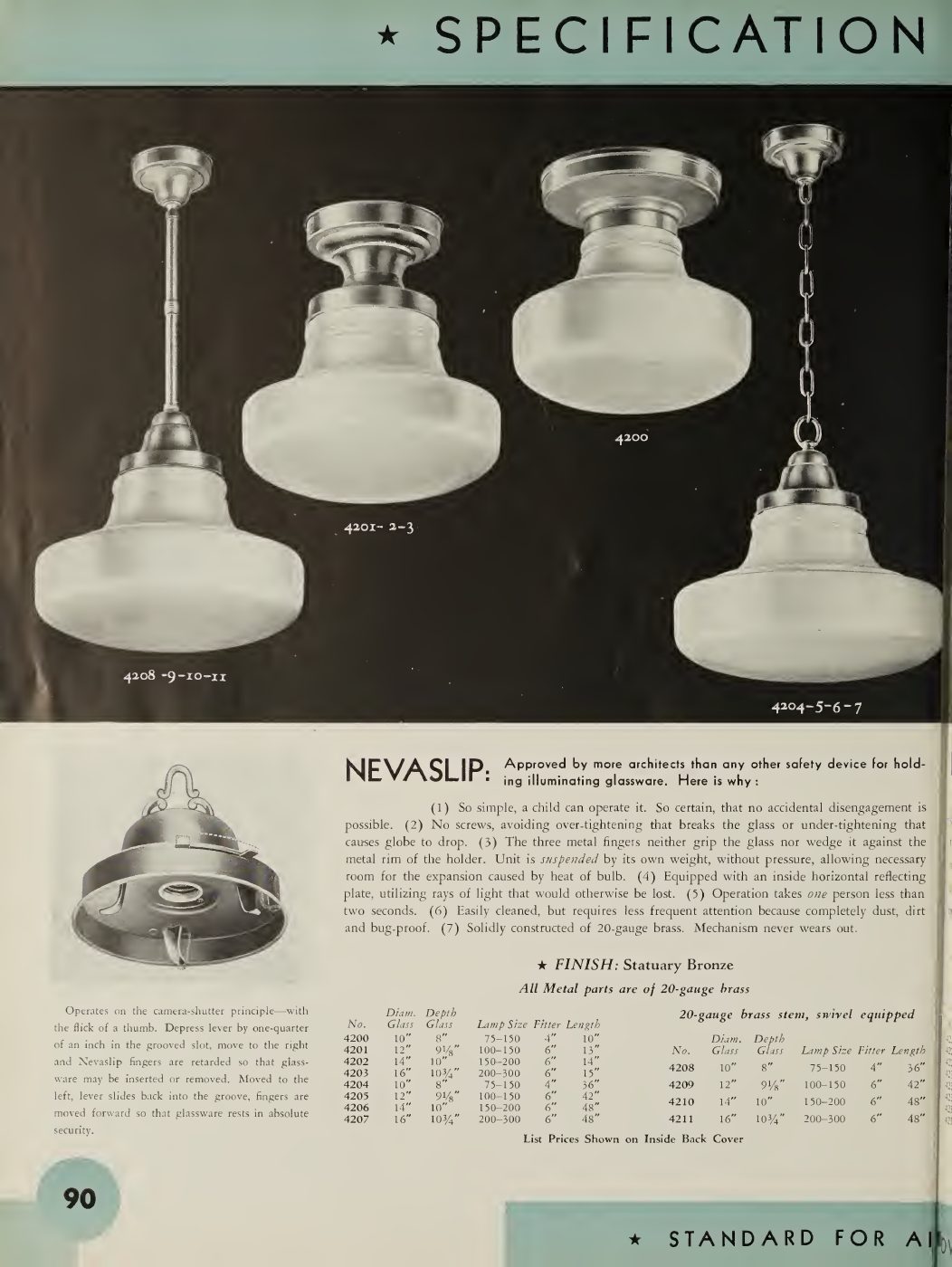
In its 1934–1935 Style Book, Lightolier presented these lights in a section for stores, schools, and public buildings. The catalog called them “Specification Lightoliers” and called the opal-glass line NuDay; it did not use the modern marketplace phrase “schoolhouse light” on this plate.
Model 4200 sits close to the ceiling; models 4201 through 4203 use short rigid stems; models 4204 through 4207 use chain; and models 4208 through 4211 use longer rigid stems. A 10-inch glass takes a 4-inch fitter in this documented line; the 12-, 14-, and 16-inch glasses use 6-inch fitters. Those are maker-specific specifications, not a universal conversion rule.
Inspect scan position 94 in the complete Internet Archive copy, including the holder diagram and printed dimension tables.
Before buying glass
Match the holder, not just the outline
| Check | Measure or photograph | Why it matters |
|---|---|---|
| Fitter | Outside diameter of the glass neck and inside opening of the holder. | The nominal size must agree, but the retaining method and tolerances still need checking. |
| Retention | Thumb screws, spring clips, fingers, lip, and any chips or altered parts. | A similarly sized opening does not make unlike support systems interchangeable. |
| Clearance | Shade height and width, socket position, bulb envelope, and ventilation space. | A neck can fit while the glass still collides with the socket, canopy, or ceiling. |
| Overall drop | Ceiling to the lowest point of the installed fixture. | The same shade can work as a flush, semi-flush, or pendant light with very different headroom. |
The shade-fitter measuring guide shows the exact neck, holder, body, and height reference points. If the holder is damaged, improvised, or difficult to identify, have a qualified lighting restorer inspect it rather than relying on glass friction or over-tightened screws.
Current reproductions by task
Choose a complete fixture or measured replacement glass
These current Amazon listings cover three genuinely different needs: a suspended light, a compact semi-flush fixture, and glass only for a compatible 4-inch holder. They are modern reproductions, not antique Lightolier products. Confirm current dimensions, finish, seller, price, and availability on Amazon before ordering.
As an Amazon Associate, Old House Lights earns from qualifying purchases. Prices and availability are shown on Amazon and may change.
 Amazon pick
Complete pendant
Gold Schoolhouse Milk-Glass Pendant
A compact gold-finish pendant with an opal milk-glass schoolhouse shade for a kitchen, bath, or hall.
Amazon pickLower ceiling
Opal Schoolhouse Semi-Flush Ceiling Light
A twelve-inch opal milk-glass schoolhouse globe on a compact gold-finish ceiling mount.
Amazon pickReplacement glass
Opal Schoolhouse Replacement Shade
An opal milk-glass schoolhouse shade with an 8½-inch body and a 4-inch fitter opening.
Research source
Lightolier Company, Lightolier Style Book 1934–1935: Distinctive Lighting Fixtures and Lamps (1934), printed page 90, scan position 94. Avery Architectural and Fine Arts Library, Columbia University Libraries; digitized by Internet Archive for the Building Technology Heritage Library. Open the cited scan page.